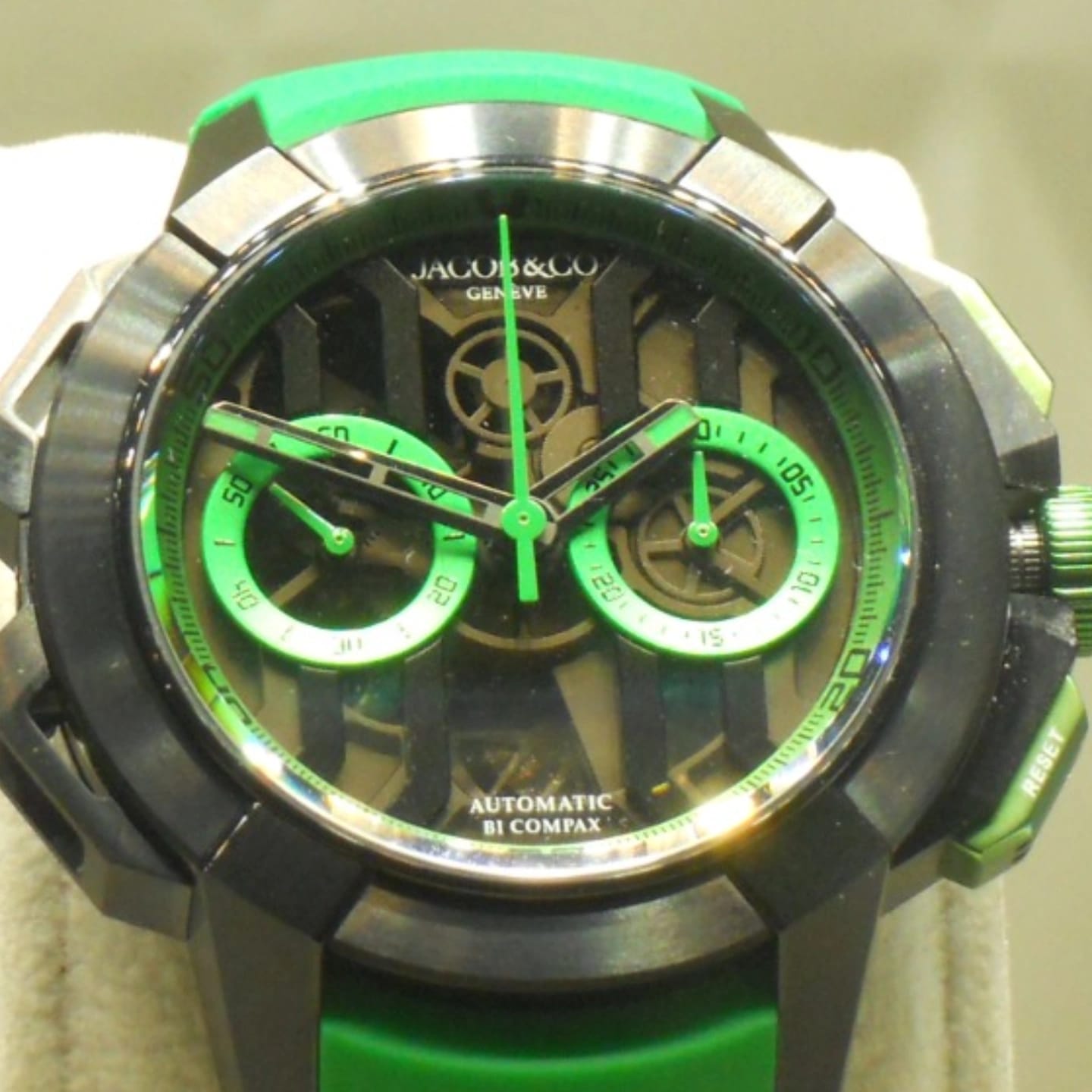

Front view
Dial, hands and bezel as delivered.
Case-back view
Case-back engraving and, where fitted, the sapphire display.
Movement
Calibre with its finishing and decoration.
On the wrist
Worn shot for proportion and strap drape.
Girard-Perregaux · Free Bridge
Girard-Perregaux Free Bridge 43 mm Slate Carbon
Reference 33190OR.64
Reference at a glance
- Brand
- Girard-Perregaux
- Collection
- Free Bridge
- Model
- Girard-Perregaux Free Bridge 43 mm Slate Carbon
- Reference number
- 33190OR.64
- Year / era
- 1953 · 1950s — pre-quartz mechanical era
- Complication
- Time only
- Movement
- In-house automatic chronograph
- Case material
- Carbon TPT
- Dial type
- Slate grey
- Strap / bracelet
- Rubber strap with titanium clasp
- Water resistance
- 200 m
- Limited-edition status
- Regular production, not a limited edition
Case, dial & bracelet
- Case dimensions
- 43 mm
- Case thickness
- 9.4 mm
- Case material
- Carbon TPT
- Bezel
- Fixed brushed titanium
- Crystal
- Anti-reflective sapphire, double-domed
- Dial
- Slate grey
- Hands
- Faceted dauphine hands, polished by hand
- Indexes
- Printed minute track with applied batons
- Bracelet / strap
- Rubber strap with titanium clasp
- Clasp / buckle
- Pin buckle in matching case metal
- Water resistance
- 200 m
Movement
- Movement / calibre
- Calibre 49F — In-house automatic chronograph
- Movement type
- Automatic, self-winding
- Frequency
- 21,600 vph (3 Hz)
- Power reserve
- 45 hours
- Number of jewels
- 33 jewels
- Complications
- Time only
- Functions
- Chronograph, tachymeter, date
- Watchmaker
- The calibre is built in-house and adjusted in five positions before delivery.
Production & market
- Production period
- 1953 – 1961
- Limited-edition quantity
- Not applicable
- Current market information
- Values have stabilised after the 2022 correction; condition and box-and-papers drive the premium.
Designer
Emmanuel Gueit
Emmanuel Gueit came from a family of Geneva jewellers and was barely into his twenties when he drew the oversized Royal Oak Offshore in 1993 — a watch the house's traditionalists resisted and collectors turned into an icon.
Historical significance
Girard-Perregaux Free Bridge 43 mm Slate Carbon sits within Girard-Perregaux's Free Bridge line, introduced in 1953. It carries the house codes established since 1791 — carbon tpt case, slate grey dial and in-house automatic chronograph — and is one of the references collectors use to date the evolution of the collection.
Interesting facts
- The bracelet tapers across its length, which is why the profile looks thinner on the wrist than the specification suggests.
- The movement's bridges are decorated even where they will never be seen once the watch is cased.
The House
Girard-Perregaux
Brand facts
- Founding year
- 1791
- Founder
- Jean-François Bautte
- Headquarters
- Switzerland
- Tier
- Luxury
- Major collections
- Laureato, Three Bridges, Free Bridge, Vintage 1945, Casquette
- Signature technologies
- In-house hairspring production · Anti-magnetic silicon escapement · Certified chronometer regulation
- Famous movements
- In-house manual-winding · In-house automatic, Superlative Chronometer · In-house automatic, chronometer certified · In-house automatic chronograph
- Notable watches
- Girard-Perregaux Laureato 39 mm Green Carbon (1964) · Girard-Perregaux Laureato 39 mm Green Stainless (1985) · Girard-Perregaux Laureato 43 mm Mother-of-pearl 18k (1956) · Girard-Perregaux Laureato 37 mm Meteorite Quartz (1987)
Brand history
Girard-Perregaux has spent more than 235 years refining a single idea: a watch should outlive its owner. From the earliest workshop pieces to today's Laureato, the house has balanced technical ambition with a recognisable design language, and its collections remain among the most closely followed by collectors worldwide.
Jean-François Bautte established Girard-Perregaux in 1791, working from Switzerland at a time when precision was measured by hand. The founder's obsession with finishing and accuracy still defines every Girard-Perregaux calibre produced today.
Historical milestones
1791
Jean-François Bautte founds Girard-Perregaux in Switzerland.
1831
Girard-Perregaux earns its first international recognition for precision timekeeping.
1969
The quartz era forces Girard-Perregaux to redefine mechanical watchmaking.
1990
Girard-Perregaux enters the modern collector market with its signature lines.
2024
Girard-Perregaux continues to produce Laureato, Three Bridges, Free Bridge and other icons in limited numbers.
More Free Bridge
Girard-Perregaux Free Bridge 39 mm Mother-of-pearl 18k
Ref. 70492OR.55
Girard-Perregaux Free Bridge 41 mm Meteorite Platinum
Ref. 84008OR.45
Girard-Perregaux Free Bridge 37 mm Green Carbon
Ref. 60373OR.98
Girard-Perregaux Free Bridge 44 mm Salmon Ceramic
Ref. 54120OR.67
Girard-Perregaux Free Bridge 39 mm Silvered Stainless
Ref. 76819ST.46