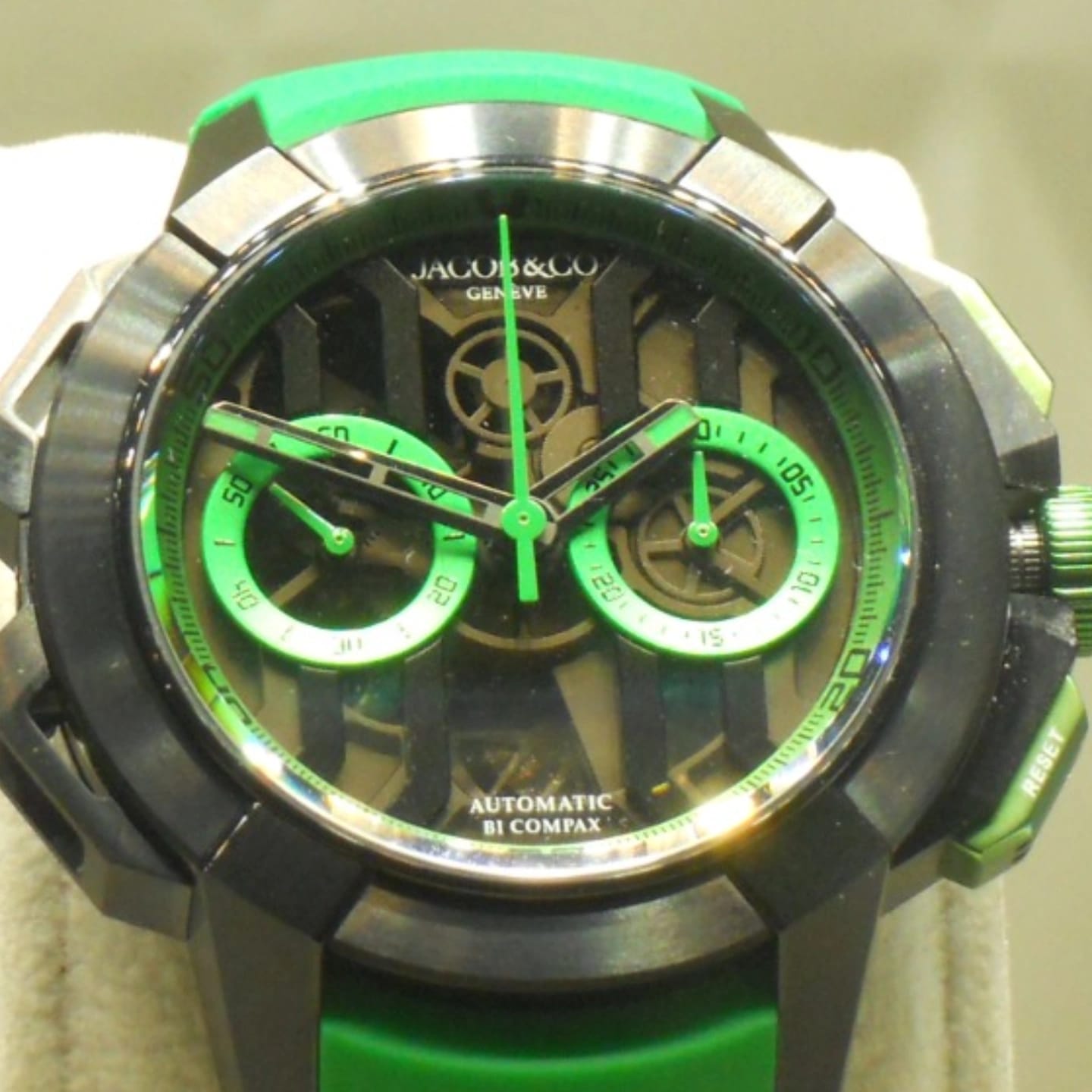


Front view
Dial, hands and bezel as delivered.

Case-back view
Case-back engraving and, where fitted, the sapphire display.
Movement
Calibre with its finishing and decoration.
On the wrist
Worn shot for proportion and strap drape.
Seiko · Presage
Seiko Presage 44 mm Blue 18k
Reference 95310OR.31
Reference at a glance
- Brand
- Seiko
- Collection
- Presage
- Model
- Seiko Presage 44 mm Blue 18k
- Reference number
- 95310OR.31
- Year / era
- 1960 · 1960s — pre-quartz mechanical era
- Complication
- GMT / second time zone
- Movement
- Eco-Drive solar quartz
- Case material
- 18k yellow gold
- Dial type
- Blue "Grande Tapisserie"
- Strap / bracelet
- Alligator leather with folding clasp
- Water resistance
- 150 m
- Limited-edition status
- Regular production, not a limited edition
Case, dial & bracelet
- Case dimensions
- 44 mm
- Case thickness
- 12.6 mm
- Case material
- 18k yellow gold
- Bezel
- Bidirectional 24-hour Cerachrom
- Crystal
- Box sapphire with AR coating
- Dial
- Blue "Grande Tapisserie"
- Hands
- Rhodium-plated baton hands with luminous fill
- Indexes
- Applied Roman numerals
- Bracelet / strap
- Alligator leather with folding clasp
- Clasp / buckle
- Titanium deployant clasp
- Water resistance
- 150 m
Movement
- Movement / calibre
- Calibre 79B — Eco-Drive solar quartz
- Movement type
- High-frequency automatic
- Frequency
- 25,200 vph (3.5 Hz)
- Power reserve
- 10 days
- Number of jewels
- 25 jewels
- Complications
- GMT / second time zone
- Functions
- GMT second time zone, date
- Watchmaker
- Finishing, assembly and timing are carried out in the manufacture's own atelier.
Production & market
- Production period
- 1960 – 1974
- Limited-edition quantity
- Not applicable
- Current market information
- Trades close to retail on the secondary market, with steady demand for full-set examples.
Designer
Gérald Genta
Gérald Genta (1931–2011) trained as a goldsmith in Geneva and became the most influential watch designer of the 20th century. Working freelance, he sketched the Audemars Piguet Royal Oak overnight in 1970, followed by the Patek Philippe Nautilus, the IWC Ingenieur SL and the Bulgari Bulgari — defining the integrated-bracelet luxury sports watch as a category.
Historical significance
Seiko Presage 44 mm Blue 18k sits within Seiko's Presage line, introduced in 1960. It carries the house codes established since 1881 — 18k yellow gold case, blue "grande tapisserie" dial and eco-drive solar quartz — and is one of the references collectors use to date the evolution of the collection.
Interesting facts
- The movement's bridges are decorated even where they will never be seen once the watch is cased.
- The case is finished by hand, alternating polished and satin-brushed surfaces in a single pass so the edges stay razor sharp.
The House
Seiko
Brand facts
- Founding year
- 1881
- Founder
- Kintaro Hattori
- Headquarters
- Japan
- Tier
- Japanese
- Major collections
- Prospex, Presage, King Seiko, Astron, 5 Sports
- Signature technologies
- In-house hairspring production · Proprietary case-hardening and polishing · Hand-applied guilloché dials
- Famous movements
- Eco-Drive solar quartz · High-accuracy quartz · Spring Drive · Automatic, 24 jewels
- Notable watches
- Seiko Prospex 36 mm Green Stainless (1952) · Seiko Prospex 38 mm Black 18k (1977) · Seiko Prospex 38 mm Meteorite Platinum (1972) · Seiko Prospex 42 mm Green Sapphire (1997)
Brand history
Seiko has spent more than 145 years refining a single idea: a watch should outlive its owner. From the earliest workshop pieces to today's Prospex, the house has balanced technical ambition with a recognisable design language, and its collections remain among the most closely followed by collectors worldwide.
Kintaro Hattori established Seiko in 1881, working from Japan at a time when precision was measured by hand. The founder's obsession with finishing and accuracy still defines every Seiko calibre produced today.
Historical milestones
1881
Kintaro Hattori founds Seiko in Japan.
1899
Seiko earns its first international recognition for precision timekeeping.
1969
The quartz era forces Seiko to redefine mechanical watchmaking.
1990
Seiko enters the modern collector market with its signature lines.
2024
Seiko continues to produce Prospex, Presage, King Seiko and other icons in limited numbers.